Network Capex vs Opex: A Finance Leader's Guide for Canadian SMBs
April 15, 2026

For twenty years, network hardware was a capital purchase and nobody asked questions. That default is gone. Here is how Canadian CFOs should actually think about the refresh cycle.

For two decades, network hardware was a capital purchase and nobody asked questions. Firewalls, switches, access points, routers. Buy, depreciate, replace every five years. That default is gone. Canadian SMBs now ask the same question of their networks that they asked of Microsoft 365 a decade ago: do we really need to own this?
This article is for CFOs, controllers, and finance directors at Canadian SMBs facing a network refresh decision. It covers how network hardware actually depreciates under CRA rules. It walks through the five factors that should drive the capex vs opex call. It closes with the hybrid approach most Canadian finance leaders end up with.
Why the capex vs opex question is back on the CFO's desk
The refresh cycle is what forces the decision. Most Canadian SMB network hardware ages out at year 4 or 5. Firmware support ends, security patches stop, performance falls behind business needs. At that moment the CFO gets a quote and a choice that did not exist in the same form a decade ago.
Two things changed. First, subscription economics became normal. When Microsoft 365 replaced Office boxed software, finance teams learned to think about IT costs as monthly operating expense rather than capitalized asset. That habit now extends to networks.
Second, the cost of capital is no longer near zero. With the Bank of Canada's policy rate holding at 2.25 percent, the opportunity cost of capital tied up in depreciating hardware is a real line item. Finance leaders who treated network hardware as a rounding error during zero-rate years now run the same numbers differently.
How network hardware actually depreciates under CRA rules
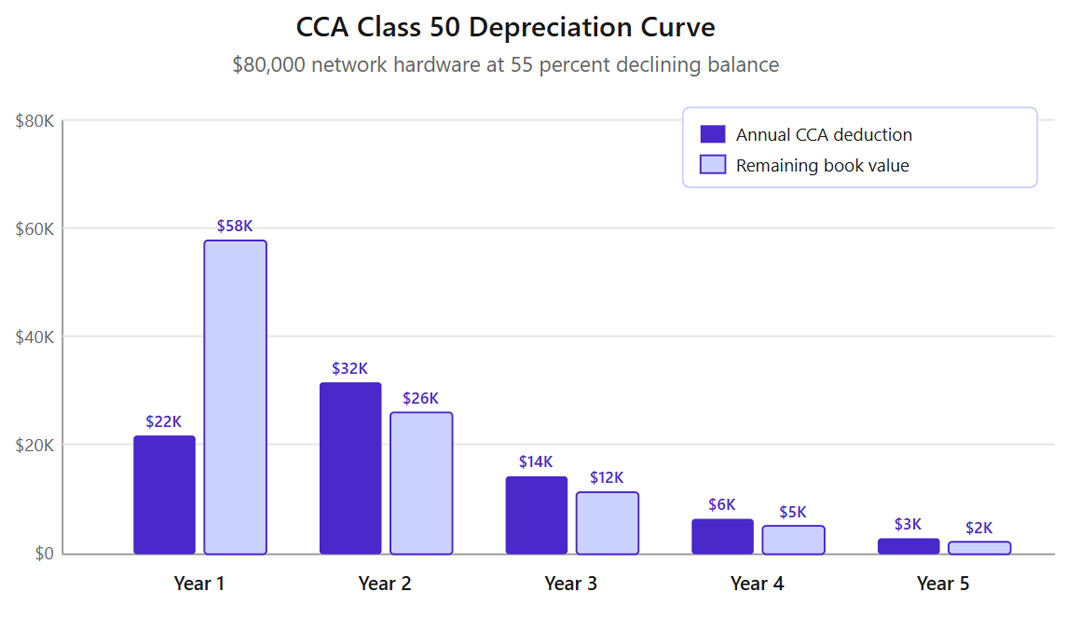
Network hardware falls under CRA Class 50 at a 55 percent declining balance rate. According to the Canada Revenue Agency's classes of depreciable property guidance, Class 50 covers general-purpose electronic data processing equipment and systems software for that equipment. The 55 percent rate is aggressive. Most of the asset value clears the books within three years.
The half-year rule applies in year one, so the effective first-year deduction is 27.5 percent. Years two and three take the bulk of the remaining value. By year four, book value is usually less than 15 percent of original cost. The tax treatment matches the operational reality reasonably well. Network hardware genuinely loses usefulness on a similar curve.
Firmware support windows matter more than the depreciation schedule. A switch at 40 percent book value that is out of vendor support is a liability, not an asset. Insurance underwriters, cyber liability carriers, and compliance auditors now ask about unsupported hardware explicitly. Finance leaders who optimize purely for tax efficiency without tracking firmware timelines end up carrying hardware the business cannot safely operate.
The five factors finance leaders should weigh
User counts, peak utilization, and vendor comparison matrices belong to the IT conversation. The capex vs opex decision belongs to finance. Five factors drive it.
Cost of capital is the first variable most Canadian SMBs underweight. Money tied up in depreciating hardware cannot earn return elsewhere. Typical Canadian SMB hurdle rates sit between 8 and 12 percent. If the hardware is worth 80,000 dollars, that capital has a real annual opportunity cost that never appears on the hardware invoice.
Growth trajectory is where the most expensive mistakes happen. Committing to 5-year hardware while the business will double in 18 months is how Canadian SMBs end up with undersized networks at year two. The decision to buy hardware today locks in an assumption about the business two and three years out. Opex models let new locations or capacity come online at monthly subscription costs rather than requiring a capital request every time.
When capex still wins
The case for capex is real and gets dismissed too quickly in vendor marketing. Stable single-location Canadian SMBs with strong cash positions and known 5-year plans still benefit from the capital approach. The hardware gets used for its full useful life. The depreciation matches operational reality. The total 5-year cost is usually lower than equivalent opex subscription fees.
Capital-rich businesses with tax-loss carryforwards see less value from opex's deduction advantage. In these cases capex captures the asset on the balance sheet without sacrificing the tax position.
Industries with sovereignty requirements sometimes require directly owned infrastructure. Certain government contractors, some financial services sub-sectors, and organizations with specific data residency obligations may face compliance complications when network infrastructure sits inside a provider's managed environment.
When opex wins
Multi-location Canadian SMBs almost always benefit from opex. Deploying hardware across 3, 5, or 10 sites as capex creates large upfront costs and the need to manage per-site refresh timing. One site ages out in March, another in September, another in December. The refresh calendar becomes a standing project. Opex flattens both the cost profile and the calendar.
Businesses in rapid growth or acquisition mode need networks that scale without capital negotiations. Opex models let new locations come online at monthly subscription costs rather than requiring a capex request for every office opening.
SMBs without dedicated IT staff benefit from opex's bundled management. Managed network services typically include:
- 24/7 network monitoring and incident alerting
- Firmware updates and security patching across all devices
- Configuration changes, VLAN updates, and policy adjustments
- Hardware replacement under the contract if devices fail
- Quarterly or monthly service review and reporting
- After-hours support and emergency response
For a company with one or two IT people, the operational support can be worth more than the hardware. The opex contract is partly a hardware subscription and partly an outsourced network operations team.
IDC's 2021 forecast projected the Network-as-a-Service market would grow at a 34.5 percent compound annual rate through 2026. Actual adoption has lagged the forecast, but the direction is consistent. North American mid-market finance leaders are slowly but steadily shifting away from pure capex network refresh cycles.
The hybrid model most Canadian SMBs land on
Canadian SMBs rarely land on pure capex or pure opex after running the numbers. The common destination is a hybrid that matches each asset class to the right financial model.
Structured cabling is capex. It lasts 15 to 20 years. Firmware is not a concept. It does not become obsolete at a software cadence. Capital invested in cabling compounds value across multiple hardware refresh cycles. Trying to subscribe to cabling makes no financial or operational sense.
Firewalls, switches, and access points with firmware dependencies and 3 to 5 year useful lives fit opex better. The subscription includes the refresh, so the hardware gets replaced during the contract rather than at the end of its book life. The operational team handling the upgrade is usually included in the subscription too.
Management services (monitoring, incident response, configuration changes, reporting) are opex by definition. They are labour, not assets.
The hybrid model treats each category separately instead of forcing one financial approach across the whole network.
Cash flow math: a working comparison
Consider a 75-person Canadian SMB planning a full network refresh. The capex path costs 65,000 dollars in hardware plus 15,000 dollars in deployment labour. The opex path runs 1,800 dollars per month over 60 months with management services included. On paper the capex total looks lower. On cash flow, tax, and operational terms the comparison is more nuanced.
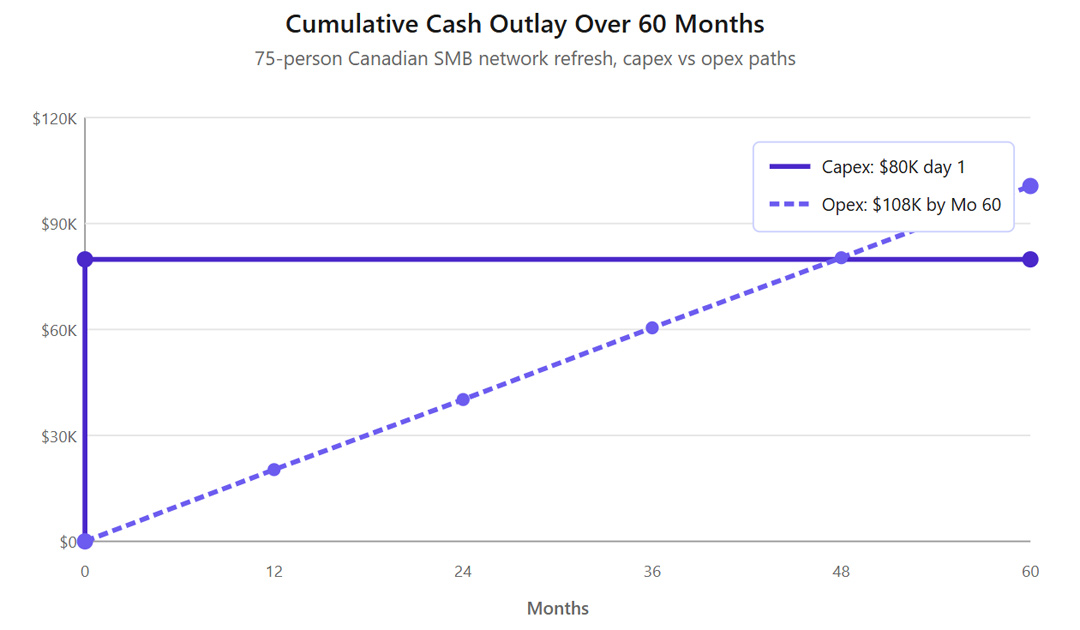
The chart shows the headline comparison but hides the important details. The capex total of 80,000 dollars does not include ongoing management, monitoring, firmware updates, or mid-cycle hardware replacement if a device fails. The opex total of 108,000 dollars includes all of those. Comparing bare hardware cost to bundled subscription cost is not a like-for-like comparison.
Capex has lower total cash outflow. Opex has higher total deduction, immediately matched to each year's expense. The comparison that matters is total cost of network ownership over 60 months. Add management labour, firmware maintenance, incident response, and mid-cycle replacement costs to the capex side. The gap narrows or inverts depending on the business.
What the managed services conversation should sound like
A good conversation about the capex vs opex decision starts with the business, not the hardware. Growth plans, cash cycle, tax position, internal IT capacity. A provider that opens with a hardware catalogue is selling hardware. One that opens with financial and operational questions is selling a network that fits the business.
Co-managed arrangements exist in the Canadian SMB market for finance leaders who want their own IT team to retain operational control. A managed provider handles design, deployment, and after-hours coverage. This works well for larger SMBs with dedicated IT staff who want external delivery capability without giving up daily operations.
Fully managed network services make sense for SMBs that want single-vendor accountability, predictable monthly costs, and internal IT freed to focus on applications and business projects. The finance conversation shifts from capital requests to monthly subscription lines. The network performance conversation shifts from internal troubleshooting to service review meetings. MCK's fully managed network services for Canadian SMBs cover design, deployment, monitoring, and support under one monthly contract.
According to Statistics Canada's 2023 Survey of Digital Technology and Internet Use, 48 percent of Canadian businesses used cloud computing in 2023, up from 45 percent in 2021. The direction of travel on business models is clear. Canadian mid-market network spending is following the same curve.
The default stopped being the default
For twenty years, the default was capex. Buy the hardware. Depreciate it. Replace it. Nobody questioned the model because there was no alternative worth the conversation.
That is no longer true.
The cost of capital is higher than it was. The refresh cycle is shorter than it was. The business changes faster than a 5-year capital plan can absorb. The management overhead of a network has grown. The subscription alternative became real.
A CFO running the same capex decision their predecessor ran in 2015 is using the wrong model on the wrong assumptions. The math that worked when money was free and networks sat still does not work when money has a cost and networks change every quarter.
Capex still wins in specific cases. Opex still loses in specific cases. The hybrid is usually the right answer. But the question itself has changed. The CFO who assumes capex by default now pays for the assumption.
If the network refresh plan looks like the one from 2015, the plan is already wrong.
Managed Networks
