SD-WAN Rollout Sequencing for Canadian Multi-Location Retailers
April 10, 2026

Most SD-WAN failures are sequencing failures, not technology failures. Here is how Canadian retailers roll out across 10, 20, or 100+ locations without breaking store operations.

Most SD-WAN project failures are sequencing failures, not technology failures. The platform selected matters less than the order in which sites cut over, how the pilot is designed, and who owns operations the day after go-live. Vendor marketing focuses on platform selection because that is where the purchase happens. The rollout is where the money actually gets spent.
This playbook is for Canadian retail IT directors sequencing an SD-WAN deployment across 10, 50, or 200 sites. Specialty chains with stores in the Toronto, Montreal, Vancouver, and Calgary markets. Convenience operators with footprints that stretch from the Maritimes to Western Canada. Shopping retailers managing a mix of flagship locations and suburban stores. The decisions below apply whether the footprint is 15 stores or 1,500.
Why Sequencing Matters More Than Platform Selection
Canadian retailers running 10 or more locations usually discover SD-WAN through one of three triggers. An MPLS contract expiry. A failed cloud POS rollout. An acquisition that added sites with incompatible networks. Each trigger implies a different rollout shape. An MPLS-driven rollout has a hard deadline and a cost-reduction business case. A POS-driven rollout has performance targets at specific locations. An acquisition-driven rollout has to unify two different operational cultures before it unifies two networks.
A rollout plan is not a project plan. The rollout plan covers which sites cut over in which order, what the fallback is if a site fails, and who owns each decision point. The project plan covers tasks, dates, and dependencies. Confusing the two produces rollouts that finish on time and break store operations anyway.
Gartner's forecast projects 70 percent of enterprises will have implemented SD-WAN by the end of 2026, up from around 45 percent in 2021. The platforms have matured. The vendor market has consolidated. What separates successful rollouts from painful ones is almost entirely on the deployment side.
Readiness Before Rollout: What Has to Be True at Week Zero
Network inventory is the single most underestimated readiness task. Canadian multi-location retailers routinely discover 15 to 30 percent more network devices at remote sites than the head office records show. Old modems, forgotten VPN routers, printer servers still on the network, payment terminals on their own circuits. Every one of them becomes a cutover risk. A real inventory takes two weeks across a 50-site footprint and cannot be rushed.
Application dependency mapping should happen before site one cuts over. Which applications hit which data centres, which rely on local servers, which need specific quality of service treatment. Retail POS systems, payment processing, inventory management, video surveillance, loyalty platforms, and back-office analytics each have different latency and reliability profiles. A flagship store on Toronto's Queen Street has different application needs than a convenience store in suburban Mississauga, even if both belong to the same chain.
Underlay circuits need to be ordered before overlay configuration begins. A 50-site rollout with 50 new fibre circuits can take 90 to 150 days just for circuit provisioning, depending on carrier mix and address serviceability. Starting SD-WAN configuration before circuits are live wastes project budget on rework and creates false confidence about timelines.
Pilot Site Selection
Pilot sites should be representative of the complexity the rollout will face, not the easiest sites to get live. Choosing the head office or a Toronto flagship as pilot produces a successful pilot and a failed rollout. The lessons do not transfer to the smaller, harder, more constrained sites that make up most of the footprint.
A good pilot set covers three shapes:
- One urban site with standard fibre availability, typical operating hours, and a clean inventory
- One suburban or smaller-market site with limited carrier options, where circuit resilience is tested
- One site with unusual operational requirements such as extended hours, on-premises servers, or legacy payment hardware
Three pilot sites, not one. A single-site pilot tells the project team what works at that site. It tells them almost nothing about what will work across the rest of the footprint.
Pilot duration should be at least 30 days under real operational load, including a peak traffic period like month-end, a promotional weekend, or a payroll cycle. Pilots that end after a quiet two weeks miss the failure modes that matter most.
Circuit Strategy Across the Footprint
Dual-carrier circuit strategy is rarely justified at every site. A typical Canadian retail rollout uses dual circuits only at the top 15 to 20 percent of locations by revenue, with LTE or 5G failover covering the remaining 80 percent. This balances resilience against monthly cost. A flagship store generating $6 million in annual revenue justifies redundant fibre. A convenience store in a small Ontario town does not.
Broadband cable plus LTE failover outperforms single-fibre circuits for many Canadian retail sites, especially outside major urban markets. Cable provides enough throughput for POS, inventory sync, and cloud applications. LTE handles outages. Both cost less than enterprise fibre and install faster. The CRTC's 2024 wholesale fibre access policy has expanded the pool of providers able to deliver service to retail addresses, but for many locations cable remains the practical choice.
SD-WAN does not fix bad underlay. A site with a congested residential-grade cable circuit will perform badly on SD-WAN, just differently than it did on MPLS. Circuit quality assessment should happen per site during readiness, not during cutover. The pattern shows up most often in small-market specialty retail, where landlords have selected the cheapest available service for the building.
Security and Compliance Layered Into Rollout
PCI DSS 4.0 raises the bar for network segmentation at retail sites. POS traffic, guest Wi-Fi, back-office systems, video surveillance, and digital signage all need separate VLANs with documented traffic flows. The Payment Card Industry Security Standards Council made the full set of 4.0 requirements mandatory as of March 31, 2025, including annual segmentation testing. SD-WAN rollouts that skip segmentation create compliance gaps that surface at the next audit.
Direct internet breakout for SaaS traffic is one of SD-WAN's biggest performance gains and biggest security risks. Breaking out cloud traffic locally means each retail site becomes a potential attack surface. Cloud-delivered security addresses this but adds per-user or per-site subscription cost. The trade-off is real. Every rollout has to decide where to land on it.
PIPEDA obligations do not change with SD-WAN, but their visibility does. Centralized logging across sites exposes personal information flows that were previously hidden in per-site systems. Loyalty program data, employee access patterns, and customer Wi-Fi logs all become visible from a single dashboard. This is a feature for compliance teams. It can be a surprise for IT teams who assumed the project was purely about network performance.
Rollout Waves: Sequencing 5, 20, or 100-Plus Locations
Rollout shape scales with footprint size. Rollouts under 10 sites can sequence linearly. One site per week, lessons learned applied to the next. Rollouts between 20 and 100 sites need wave-based sequencing with 5 to 10 sites per wave, 2 weeks between waves. Over 100 sites, waves run in parallel with dedicated deployment crews handling separate regions.
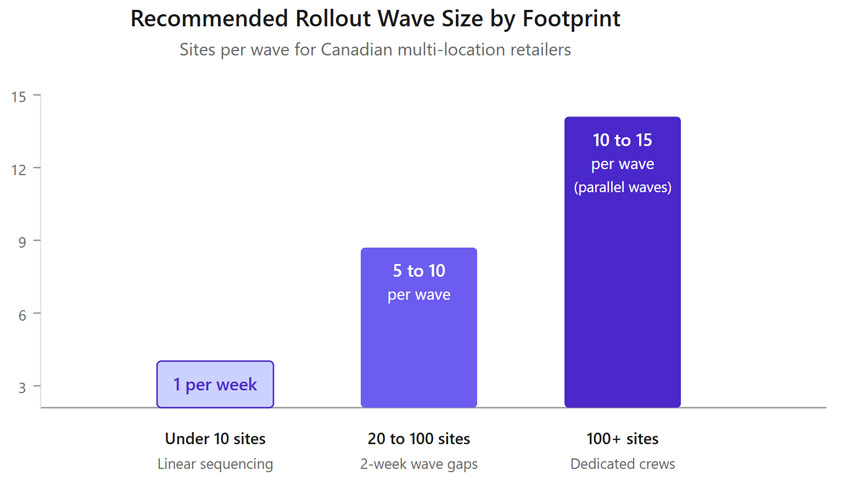
Wave sequencing should follow operational risk, not geography. The instinct is to group sites by province or region: all Ontario stores in wave one, all Quebec stores in wave two, all Western Canada in wave three. The better approach groups sites by operational complexity. All standard-format stores in wave two, all high-volume urban stores in wave four, all sites with legacy payment or inventory systems last. The geography gets handled inside each complexity tier.
Cutover windows for retail should avoid seven operational periods: Black Friday, Boxing Week, back-to-school, Mother's Day, Father's Day, Valentine's Day, and the final two weeks of each fiscal quarter. A 100-site rollout that ignores these loses operational trust fast. Quebec-based retailers should also plan around Saint-Jean-Baptiste weekend and the construction holiday period in late July.
Operational Handoff and Day-Two Management
Day-two operations are different work from day-one deployment. The people who roll out SD-WAN well are rarely the same people who run it well. Build the operational team before the last site cuts over, not after. A retailer with 80 sites live on SD-WAN and no operational team in place is one outage away from a reputation problem.
Centralized dashboards replace per-site troubleshooting, but only if someone is watching them. Cloud-managed SD-WAN platforms generate alerts at a volume that requires either dedicated network operations staffing, tuned alert thresholds, or both. An unmonitored dashboard is a liability, not an asset.
Vendor support contracts rarely cover operational reality. Most include hardware replacement and platform support. They do not cover circuit troubleshooting with local carriers, application performance issues at individual stores, or site-level configuration changes when a location adds new POS terminals or video systems. Statistics Canada's 2025 Canadian Survey of Cyber Security and Cybercrime shows Canadian retailers facing higher network-related incident rates than the broader SMB average. Day-two response time is a material business concern, not a line item in the vendor contract.
When to Partner, When to Build In-House
Internal IT teams at Canadian retailers typically handle SD-WAN well up to about 25 sites. Beyond that, the operational load exceeds what a small team can cover without becoming reactive. The 25-site mark is where most retailers either hire dedicated network operations staff or move to a managed service. Waiting until 50 or 75 sites usually means catching up from behind.
Co-managed engagements work well for retailers who want operational control but need architecture, project delivery, and after-hours support from an external team. The managed services partner handles design, rollout sequencing, and 24/7 monitoring. The internal team handles vendor relationships, user support, and minor configuration changes.
Fully managed SD-WAN engagements work best when the retailer wants predictable monthly costs and single-vendor accountability across design and operations. Internal IT stays focused on applications and business projects. MCK's managed Canadian SD-WAN services cover design, rollout sequencing, day-two operations, and ongoing optimization across Canadian multi-location retail footprints.
SD-WAN Rollouts Reward Discipline, Not Heroics
The rollouts that work are the ones that move slowly on purpose. Three pilot sites instead of one. Waves of 5 to 10 stores instead of parallel-everything. Cutover windows that respect the retail calendar. Operational teams built before the last site goes live.
The rollouts that fail almost always look the same. Vendor selection took six months. Deployment was planned around a quarterly deadline. Pilot was at the flagship. Waves followed geography. Day-two staffing was a problem for after go-live.
Platform selection gets the attention. Sequencing gets the outcome.
A retailer with 50 sites running cleanly on SD-WAN built the rollout around store operations, not around the network. A retailer with 50 sites running poorly built the rollout around the network and expected the stores to adapt. Same platform. Same hardware. Different result.
If the plan starts with which vendor to pick, the plan has already started in the wrong place.
Managed Networks
Network Security
